French doors are beautiful right up until you need privacy at night, glare control in the afternoon, or a window treatment that does not bang every time the door opens. That is why custom blinds for french doors are less about decoration alone and more about getting the fit, function, and finish exactly right.
Unlike a standard window, French doors come with moving parts, handles, shallow mounting depth, and full-glass panels that put every measuring mistake on display. Off-the-shelf options often look fine in the box and disappointing on the door. A custom solution changes that. It gives you a treatment designed around the door itself, the room it sits in, and how your household actually uses the space.
Why French doors need a different approach
French doors ask more of a window treatment than most homeowners expect. The blinds have to clear the handle, sit close enough to the glass to look intentional, and stay controlled when the door opens and closes. If they protrude too far, they can catch. If they hang loosely, they can swing. If they are measured poorly, they can leave awkward light gaps or interfere with the hardware.
This is also a place where proportions matter. A treatment that looks elegant on a bedroom window can feel bulky on a narrow glass door panel. The goal is not just to cover the glass. It is to preserve the clean architecture of the doors while adding comfort, privacy, and a finished look.
That is why custom blinds for french doors usually perform better than stock products. They are built to the exact glass dimensions, door configuration, and hardware placement, which creates a more refined result and fewer day-to-day annoyances.
The best custom blinds for french doors
There is no single best option for every home. The right choice depends on whether your priority is softness, privacy, child safety, insulation, or a tailored architectural look.
Cellular shades for a clean, practical fit
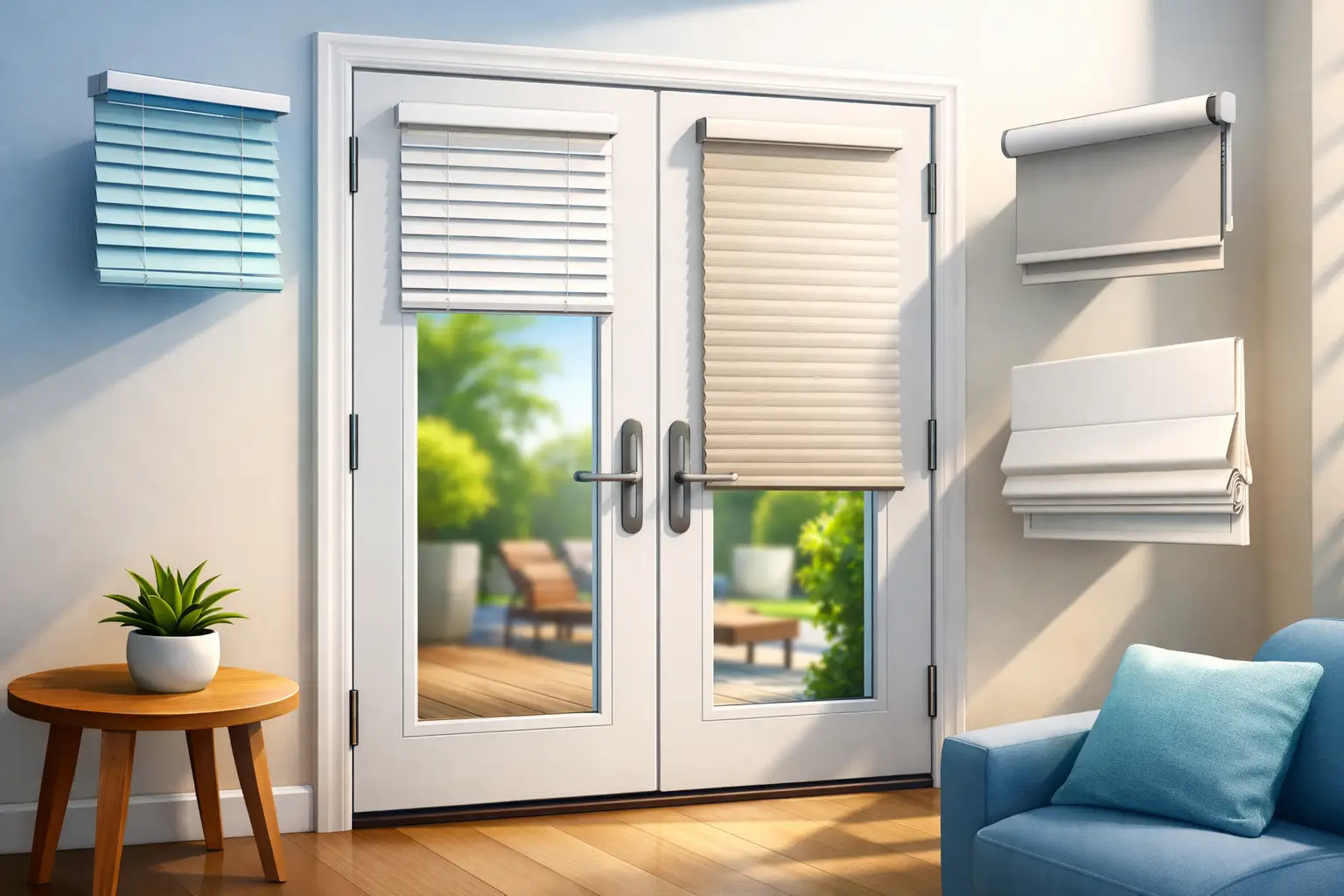
Cellular shades are one of the most popular solutions for French doors because they are slim, lightweight, and effective. They sit close to the glass, which helps reduce movement when the doors open and close. They also provide excellent insulation, which matters if your doors face strong sun or seasonal temperature swings.
For many homeowners, this is the easiest balance of style and performance. Cellular shades can look understated in a casual family room or polished in a primary suite. They also work well when you want privacy without making the doors feel heavy.
Roman shades for a softer, designer look
If the room calls for more texture and sophistication, Roman shades can be a strong choice. They bring fabric, color, and softness to a space that might otherwise feel hard or overly architectural. In dining rooms, sitting rooms, and formal living spaces, that extra layer can make the doors feel integrated with the rest of the design.
The trade-off is bulk. Roman shades usually require more projection than cellular shades, so hardware clearance and mounting depth become more important. On some French doors, especially those with prominent handles, that can limit your options.
Wood and faux wood blinds for structure and warmth
Horizontal blinds can work on French doors, particularly when a homeowner wants crisp lines and adjustable light control. Wood blinds add warmth and a higher-end furniture quality. Faux wood is often chosen for moisture-prone areas or for homeowners who want the look at a more budget-conscious price point.
That said, blinds with slats are not always the quietest or sleekest solution on an active door. They can move more than a compact shade, and the stack at the top is more visible. In the right room they look beautiful, but they are not always the best answer for every daily-use door.
Shutters for an architectural finish
Shutters offer one of the most tailored looks available. When designed specifically for French doors, they can be cut around handles and mounted directly to the door for a permanent, built-in appearance. They suit homes where craftsmanship and long-term value matter just as much as light control.
They are also durable and timeless, which makes them attractive for entry doors, patios, and upscale interiors. The main consideration is investment. Shutters tend to sit at a higher price point than many blinds and shades, though the visual impact is hard to match.
What makes a custom fit worth it
A custom treatment does more than match the size of the glass. It accounts for the details that usually get missed when homeowners try to solve French door coverage on their own.
First, there is handle clearance. Door levers and knobs can disrupt the placement of the treatment, especially if the product sits too far off the glass. A proper design takes that into account from the start.
Second, there is hold-down functionality. Many French door blinds and shades need bottom hold-down brackets or a similar feature to keep the treatment from swinging when the door moves. This small detail makes a major difference in daily use.
Third, there is consistency. French doors are usually visible from key living spaces, kitchens, and patios. If one panel sits slightly higher than the other or the fabric stack looks uneven, you notice it immediately. Custom fabrication and professional installation help avoid that uneven, almost-right look.
Choosing the right style for your room
The room should guide the decision as much as the door itself. In a breakfast area or kitchen, homeowners often want something low-profile, easy to operate, and simple to clean. In a primary bedroom, privacy and light control may take priority. In a formal front room, the look may matter most.
Sun exposure is another factor. West-facing doors can bring intense afternoon heat and glare, making insulating shades a smart investment. Doors opening onto a patio or backyard often need privacy at eye level without making the room feel closed off.
Then there is how often the doors are used. A French door that opens several times a day benefits from a treatment that stays neat and controlled. A more decorative option may work perfectly on doors that are mostly for light and visual symmetry rather than constant traffic.
Why measuring and installation matter so much
French doors are unforgiving. Even a small measuring error can create visible gaps, poor alignment, or interference with the handle and lockset. This is one reason homeowners are often disappointed by online ordering. The product itself may be fine, but the final fit is only as good as the measuring, specification, and installation.
Professional measuring helps answer questions most people do not know to ask. Should the treatment mount on the door or above it? Is there enough depth for the product selected? Will the fabric or slats clear the hardware? Do both doors need active operation, or can one side remain mostly stationary?
Installation matters just as much. A perfectly made blind can still look wrong if it is mounted slightly off, tensioned poorly, or installed without accounting for repeated door movement. On French doors, precision is not a luxury. It is the difference between a product that feels custom and one that feels improvised.
Custom blinds for french doors and the overall design of the home
One of the biggest missed opportunities with French doors is treating them like a problem to solve instead of a design feature to enhance. The right window treatment can frame the doors beautifully, tie together nearby windows, and elevate the entire room.
This is especially important in homes with open floor plans or strong sightlines. A patio door visible from the kitchen, family room, and breakfast area needs to feel intentional from every angle. Matching color, texture, and profile to the surrounding treatments creates a more cohesive and more expensive-looking result.
That is where a consultative process helps. Seeing samples in the home, under your lighting, against your trim and flooring, changes the decision. A white that looked perfect in a showroom may feel too stark in a warm-toned room. A woven texture that seemed subtle may become the element that makes the whole space feel finished. Companies like Covering Windows build their service around that kind of real-world decision-making because it leads to better outcomes and fewer regrets.
The smartest way to buy
If you are comparing options, focus on more than just the product category. Ask how the treatment will be mounted, how it will stay in place, how it will clear the handle, and what it will look like when fully raised or tilted open. Those details shape your satisfaction more than a swatch or a price tag alone.
It also helps to think in terms of value, not just cost. A cheaper blind that rattles, sags, or fits awkwardly on a highly visible set of doors rarely feels like a bargain for long. A well-chosen custom treatment tends to pay off every day in comfort, appearance, and ease of use.
French doors already add light and character to a home. The right window treatment should protect that beauty, not compete with it. When the fit is right, the operation is smooth, and the style feels true to the room, the doors stop being a challenge and start looking complete.